The advantages of a flat panel detector are not a single list that applies equally to every product in the category. They follow from a small set of specification choices that a model designation records, in one form or another: active imaging area, data link, scintillator, sensor backplane and mechanical class. Reading a detector lineup therefore means mapping each model back to those fields, then confirming that the designation written on a quotation matches the specification sheet field by field. A feature list describes what digital detectors do in general; a model family describes what a particular imaging room will actually receive.
This distinction matters at the point of purchase. Detectors described with the same generic advantages can differ in coverage, in how images leave the panel, in low-dose behaviour and in the environments they tolerate. Those differences are not marketing detail; they are the boundaries between models.
Category-level advantages are well established and are covered separately on this site: digital capture replaces film-based capture, an image becomes available for review without chemical processing, studies can be archived and routed electronically, and exposure information can be recorded alongside the image. The general advantages of flat panel detectors and the key features of a flat panel detector are described in dedicated articles.
Such statements remain true across the category, which is precisely why they do not settle a purchase. A procurement question is model-shaped: which panel covers the anatomy in one exposure, which panel connects to the generator already installed, which panel survives the handling pattern of the room. Each of those answers is attached to a specific model family rather than to the technology class. Treating a category advantage as a model guarantee is one of the common starting points for a quotation that does not match the delivered equipment.
The practical consequence is that “advantages and features” is most useful when it is read as a set of conditional statements. Each advantage holds under a specification condition, and the model designation is the shorthand that records whether the condition is met.

A detector lineup is normally organised around a limited number of fields. The site’s own product navigation reflects this structure: the DR detector range is divided into a wired cassette and a wireless cassette branch, with further grouping by detector size and by application such as mammography. Those groupings are specification fields, not slogans.
| Field | What it changes about the detector | Where the detail is covered |
|---|---|---|
| Active imaging area | Whether an anatomical region fits in a single exposure, and whether a cassette-size format can reuse an existing tray | 14×17 vs 17×17, large-format panels, specialty sizes |
| Data link | Cabling, power arrangement, portability across rooms, and the network path an image takes to the workstation | wired vs wireless detectors |
| Scintillator | Behaviour at low exposure and the resulting signal characteristics | specification values in the exam room |
| Sensor backplane | Readout architecture and its effect on noise and acquisition behaviour | a-Si, IGZO and CMOS backplanes |
| Mechanical and environmental class | Tolerance of handling, sealing, and the stated operating and storage conditions | durability specifications |
No single field identifies a model on its own. A model is the combination: a given area, on a given link, with a given scintillator and backplane, built to a given mechanical class. Two panels that share three of the five fields and differ in the fourth are different models with different advantages, even when a product page describes them in similar language.
Model designations are not standardised across the industry. Each manufacturer defines its own scheme, and a suffix that indicates one property in one catalogue can indicate something else in another. What tends to be consistent is the existence of segments rather than their meaning: a size-related segment, an interface or series segment, and occasionally a revision or option segment.
| Segment | What it typically encodes | Confirmation to request in writing |
|---|---|---|
| Size code | A nominal imaging format, commonly expressed as a compact numeric abbreviation of the active area | The exact active imaging area in millimetres, plus the pixel matrix |
| Interface or series suffix | Wired or wireless configuration, or membership of a particular product series | The connector type, power arrangement and exposure synchronisation method |
| Revision or variant marker | A generation, an option set, or a regional configuration | Which options are included and which are quoted separately |
The table above is a reading aid, not a decoding standard. A size code is a nominal label: the number appearing in a designation does not by itself state the usable imaging area, and two formats described with the same nominal label can differ at the edges. Likewise, an interface suffix does not state the synchronisation method, which is a separate line on the specification sheet.
Because designation schemes are manufacturer-specific, the reliable source for a model’s meaning is the written specification sheet that carries that exact designation. On this site the public catalogue is organised by specification family rather than by model code, so a model family is most safely identified by the combination of fields in section 2 and confirmed against documentation before an order is placed.
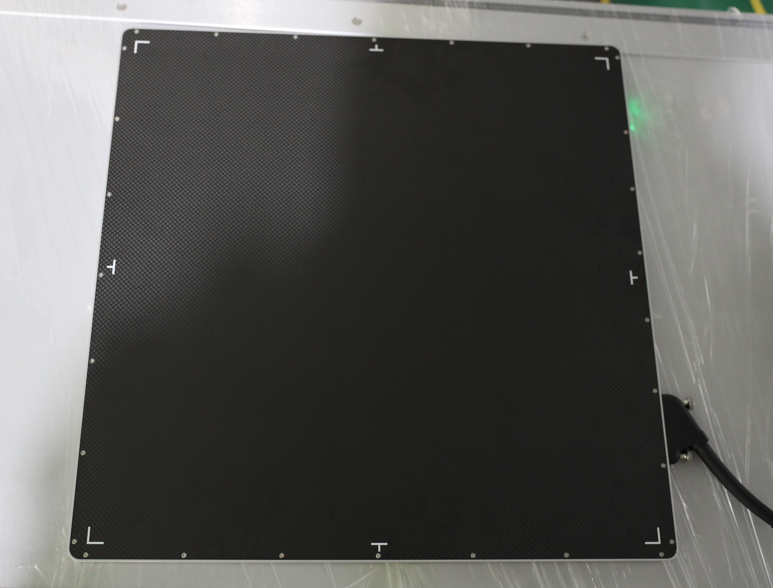
The following check concerns consistency between documents, not the interpretation of individual parameters. Parameter interpretation is covered elsewhere; the purpose here is to establish that the model named in a commercial document is the same model described in the technical document.
| Field | Why it belongs in the reconciliation | Documentary evidence to request |
|---|---|---|
| Complete model designation, including suffix and revision | Short forms omit the segment that distinguishes otherwise similar panels | A specification sheet headed with the full designation |
| Active imaging area and pixel matrix | The size code is nominal; the usable area and matrix are the measurable values | Stated active area in millimetres and matrix dimensions |
| Scintillator and sensor type | Two panels of identical format can be built on different materials and behave differently | Material declaration for both layers on the same sheet |
| Data interface and power arrangement | Determines cabling, network equipment and site preparation | Interface specification and power input description |
| Exposure synchronisation method | Determines whether the panel can be triggered by the installed generator | Written statement of the supported synchronisation approach |
| Mechanical and environmental ratings | Handling, mounting and storage assumptions attach to a specific build | Ratings as stated for that designation, with test conditions |
A discrepancy in any row means the two documents describe different configurations, even when the commercial description sounds identical. Reconciliation is a documentation exercise; it does not require laboratory measurement, and it is normally completed before a configuration is accepted rather than after delivery.
A format label identifies an imaging area class, not a fully specified panel. Within one format class there can be different scintillators, different link types and different mechanical builds. The correction is to record the full designation alongside the format label, rather than substituting one for the other.
Suffix conventions are internal to a manufacturer. A letter that denotes a wireless build in one catalogue can denote a series or a revision in another, and the same letter can change meaning between generations of one catalogue. The correction is to obtain the manufacturer’s own designation key in writing and to attach it to the quotation.
Standard cassette-size panels and large-format or application-specific panels belong to different format families, with different tray, mounting and coverage assumptions. Describing both with a single size phrase removes the distinction that determines whether an existing bucky tray can be reused. The correction is to name the format family explicitly and to record physical tray dimensions where reuse is intended. The specialty size article describes that boundary in detail.
Catalogues are revised. A designation carried over from an earlier quotation can be paired with a specification sheet from a later revision, producing a configuration that was not offered as a single product. The correction is to require that the designation, the revision marker and the sheet date appear together on one document, and to request written notice when a designation changes during a project.
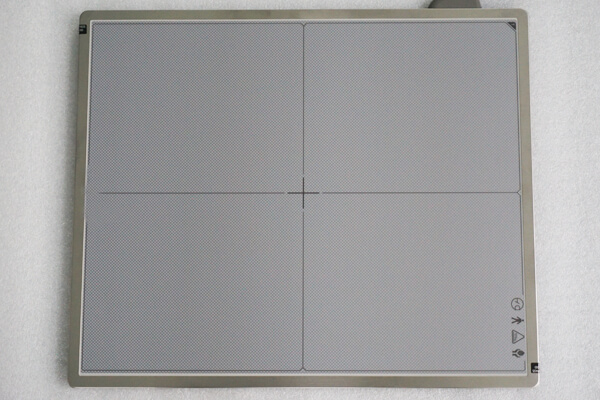
Each commonly cited advantage has a specification condition attached to it. Stating the condition is what turns a feature list into a model-level description.
| Advantage | Depends on | Condition to verify |
|---|---|---|
| Immediate image availability and fewer repeat exposures | Capture chain, exposure synchronisation and image routing | Interoperability with the installed generator and image destination confirmed in writing |
| Single-exposure coverage of large anatomy | Active imaging area | Exact active area in millimetres rather than the nominal size code |
| Dose-efficiency potential | Scintillator, calibration state and exposure-index practice | An exposure-index and quality-control programme in place; dose reduction is not automatic |
| Cable-free positioning across rooms | Wireless link and the site network | A site survey covering coverage, roaming behaviour and interference sources |
| Reuse of an existing film or CR bucky tray | Cassette-size physical dimensions and tray compatibility | Measured tray dimensions and cassette thickness compared with the panel drawing |
The pattern is consistent: the category makes an advantage possible, and the model determines whether it is realised in a given room. A detector selected on category language alone can satisfy every headline feature and still miss the condition that matters for the intended workflow.
A model confirmation normally consists of four documents: a specification sheet headed with the complete designation including suffix and revision; a written statement that the sheet corresponds to the model named in the commercial document; a list of included and separately quoted options; and an undertaking to notify a designation change in writing during the project. These documents make the fields in section 4 checkable without requiring interpretation of individual performance values.
Where a project involves reusing existing room equipment, the tray and generator compatibility statements are added to the same pack. Keeping all confirmations on one revision-controlled set of documents prevents the gradual divergence that produces a mismatched delivery.
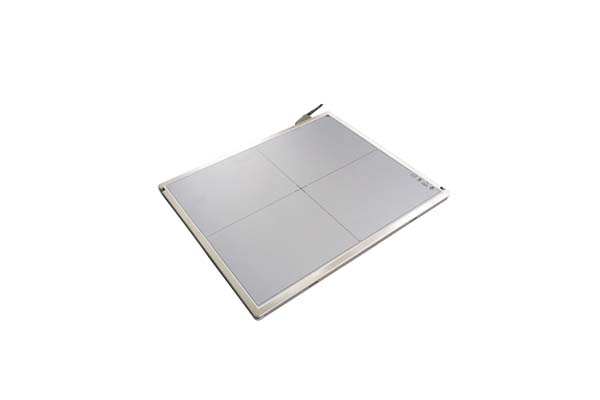
No. Designation schemes are defined by each manufacturer, and no cross-manufacturer standard governs size codes, interface suffixes or revision markers. A designation is interpretable only against the manufacturer’s own key and the specification sheet that carries it.
A larger format indicates a larger nominal imaging area. It does not indicate superior performance in other fields such as readout behaviour, low-dose characteristics or mechanical tolerance. Format choice is a coverage decision, and the remaining fields are evaluated separately for the intended application.
Yes. A shared format label does not fix the scintillator, the sensor backplane, the data link or the mechanical build. Panels within one format class can differ in all four, which is why the full designation and its specification sheet are needed together.
The two documents describe different configurations until the discrepancy is resolved. The normal step is to request a single specification sheet headed with the exact designation used in the commercial document, including suffix and revision, and to hold the configuration unconfirmed until that sheet is supplied. An earlier article on model differences discusses how sensitivity varies across models in general terms.
They are normally separate designations, because the data link, power arrangement and often the housing differ. A shared format label does not merge them into one model; the interface segment of the designation and the corresponding specification sheet distinguish them.
Specification sheets, model confirmations and configuration lists are available on request. Written confirmation of the full designation and its corresponding specification sheet is supplied before a configuration is accepted.
Phone / WhatsApp: +86 19062611512 (WhatsApp) | Email: admin@newheek.cn | Contact page
Author:Newheek-Detector
Tel:+86 19062611512
Email:admin@newheek.cn
Company:Weifang Newheek Electronic Tech Co., Ltd.