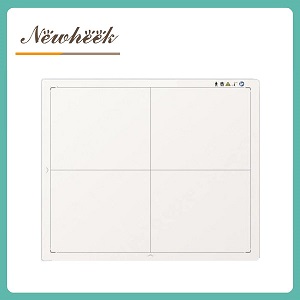
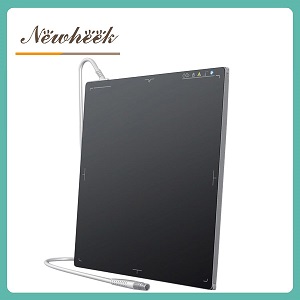
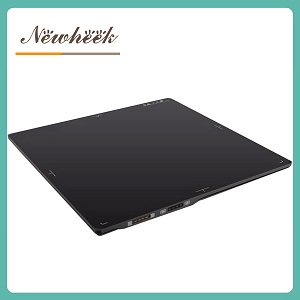
A wired flat panel detector transfers images over a physical Gigabit Ethernet cable and draws power from the room — it never runs out of battery and is the workhorse for a fixed DR room. A wireless flat panel detector sends images over dual-band Wi-Fi and runs on an internal battery, so it can move between rooms, ride in a mobile X-ray unit, or travel to bedside and off-site screening — at a higher purchase price and with battery management added to your day.
Neither type is “better” in absolute terms. Image quality is determined by the scintillator (CsI vs GOS), the pixel pitch and the AD conversion — not by how the detector is connected. The real question is workflow: where does the detector need to be, and who needs to use it? This guide walks through that decision in about five minutes.
Wired vs Wireless at a Glance
below compares the two connection types on the factors that actually affect a radiography workflow. Example figures come from our current production models: the M1417F 14×17-inch wireless detector and the V1717MX 17×17-inch tethered detector.
| Factor | Wired (Tethered) FPD | Wireless FPD |
|---|---|---|
| Data transmission | Gigabit Ethernet cable — immune to network interference | Dual-band 2.4G / 5G Wi-Fi (IEEE 802.11 a/b/g/n/ac) |
| Power | Powered through the cable; shoot all day, no charging | Rechargeable battery, typ. 3.5 h autonomy; charges in the bucky tray |
| Mobility | Bound by cable length; stays in one room | Move freely between rooms, mobile DR units, bedside, off-site screening |
| Typical weight & thickness | ≈5.8 kg, ≈25 mm (17×17 class) | ≈3 kg, ≈15 mm (14×17 cassette class) |
| Sharing between rooms | One cable per room — extra cost per room | One detector serves several rooms and a mobile unit |
| Failure modes | Cable and connector wear over years of tugging | Battery ageing, forgotten charging, Wi-Fi congestion |
| Purchase cost | Lower | Higher (battery, radio module, charging hardware) |
| Image quality driver | Identical — depends on scintillator, pixel pitch and ADC, not the link | |
No. Image quality depends on the scintillator (CsI delivers higher light output at lower dose than GOS), the pixel pitch (139–150 μm in our range) and the 16-bit ADC. Wireless transmission happens after the image is digitized, so the link type does not touch image quality.
Around 3.5 hours of continuous autonomy on current models — but in practice the detector spends most of the day in the bucky tray, where charge-in-tray keeps it topped up. Battery packs are swappable and replaced as a consumable after years of service.
Yes. Dual-panel DR software lets you assign one panel to the wall stand and one to the table. This hybrid setup is the most common answer for clinics that need both high-volume routine work and occasional portable studies.
A cassette-size wireless detector follows the ISO 4090 cassette form factor and fits standard bucky trays, which is why it is the default choice for retrofitting older film or CR rooms to DR. Send us your system model and we will confirm compatibility before you order.
Still unsure which connection fits your rooms? Tell us how many exposures you take, in how many rooms, and whether a mobile unit is involved. Leave your name, email, country and requirements in the Contact Us form below — our product manager will reply to you as soon as possible with a detector recommendation matched to your workflow. You can also reach us directly at admin@newheek.cn or WhatsApp +86 19062611512 or Tel +86 19062611512.
Related reading: How to Choose a DR Flat Panel Detector · Wireless Type Flat Panel Detector for Digital Radiography · All Wireless Detectors · All Wired Detectors
Author:Newheek-Detector
Tel:+86 19062611512
Email:admin@newheek.cn
Company:Weifang Newheek Electronic Tech Co., Ltd.