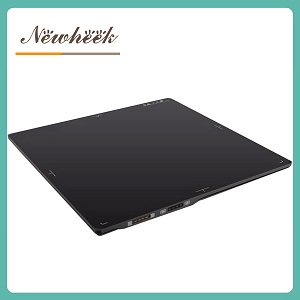
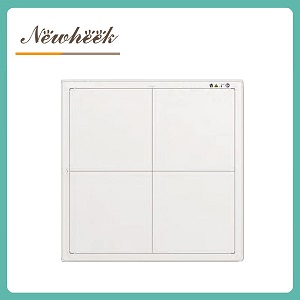
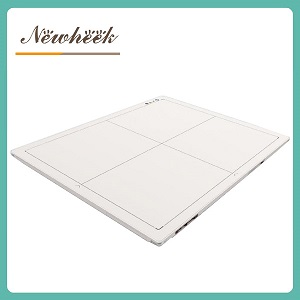
detector size controls field of view — how much anatomy one exposure covers — not image sharpness. A 14×17-inch panel (35×43 cm, rectangular) is the classic standard: it fits every bucky tray and film-based workflow, weighs less in the hand, and costs less. A 17×17-inch panel (43×43 cm, square) covers the chest and abdomen of most adults in a single exposure without rotating the panel, which is why it has become the default on new fixed DR rooms. The right rule: match the size to your largest routine anatomy and your workload — not to the biggest number on the brochure.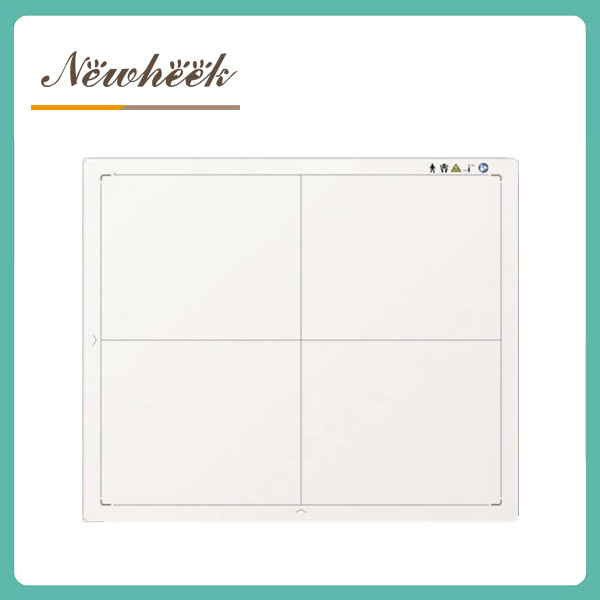
The inch figure is a nominal cassette size, inherited from the film era. What matters clinically is the active imaging area inside the housing — and here detectors that share the same nominal size can differ meaningfully. Among 17×17-class panels, active areas commonly run from about 405×405 mm up to 427×427 mm; that missing strip at the edge can decide whether a large abdomen fits in one shot. Among 14×17-class panels, active areas range from roughly 345×420 mm to 350×425 mm.
Before you order, ask the supplier to state the active area in millimeters — and put it in the contract. Two detectors labeled “17×17” are not automatically the same detector.
| Specification | M1417F (14×17 wireless) | M1717VⅡ (17×17 wireless) |
|---|---|---|
| Nominal size | 14×17 inch (35×43 cm class) | 17×17 inch (43×43 cm class) |
| Active imaging area | 350×425 mm | 427×427 mm |
| Pixel matrix | 2336×2836 | 3072×3072 |
| Pixel pitch | 150 μm | 139 μm |
| Spatial resolution | 3.3 lp/mm | 3.6 lp/mm |
| Outer dimensions | 460×460×15 mm | 460×460×15.1 mm |
| Weight (without battery) | 3.0 kg | 4.7 kg |
| Full image time | typ. 7 s | 10 s |
| Battery life | 3.5 h | 3 h |
| Ingress protection | IPX4 | — |
Two things in this table deserve attention. First, both panels share the same 460×460 mm outer cassette — so both slide into a standard bucky tray, and “will it fit my table” is rarely the deciding factor. Second, the 17×17 panel is about 57% heavier (4.7 kg vs 3.0 kg) — a difference you feel every single time the panel comes out of the tray for a tabletop view.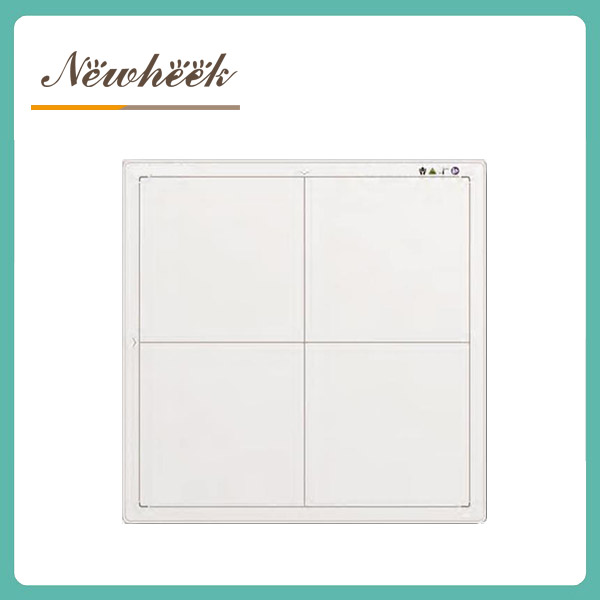
A larger panel is not free capability. Compared like-for-like on our own spec sheets: the 17×17 panel weighs ~1.7 kg more, drains its wireless battery faster (3 h vs 3.5 h), takes longer to read out a full image (10 s vs 7 s), and carries a price premium. None of these is disqualifying — but in a room where the panel is frequently hand-carried, the weight difference is the one buyers consistently underestimate.
Sharpness is set by pixel pitch, scintillator quality, and system MTF/DQE — not by field of view. Our 14×17 M1417F resolves 3.3 lp/mm at a 150 μm pitch; our 17×17 M1717VⅡ resolves 3.6 lp/mm at 139 μm. The 17×17 happens to carry the finer pitch on these models, but that is a model-by-model coincidence, not a law of physics: a 14×17 with a 139 μm pitch would out-resolve a 17×17 with a 150 μm pitch. Compare pixel pitch and DQE curves, never the inch figure. (For the layer under the pixels, see CsI vs GOS: Which Scintillator Should You Choose?)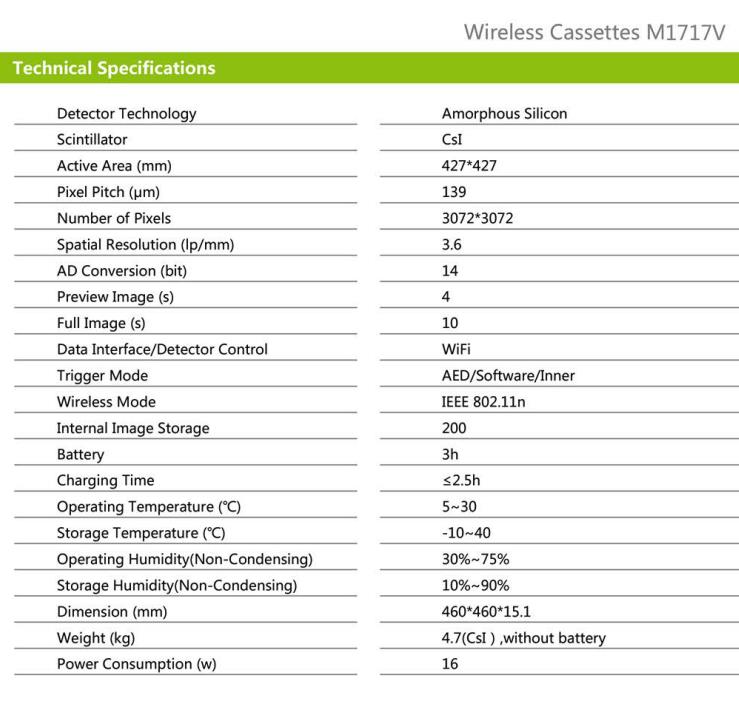
The M1717VⅡ specification sheet states the active area in millimeters: 427×427. Make this number, not “17×17”, the contractual one.
A four-question decision checklist
What is the largest anatomy you image routinely? If pelvis/lumbar/large-torso work is daily, 17×17 removes your most frequent second exposure.
Retrofit or new room? Retrofits run smoothly on 14×17; new fixed rooms lean 17×17.
How often does the panel leave the tray? Frequent tabletop work favors the lighter 14×17.
What is the stated active area in mm — and is it in the contract?
Get a size recommendation for your room, not a catalog page
Tell us your room type (retrofit or new), your main anatomy mix, and whether the panel needs to be hand-carried — our product engineers will recommend a specific size and connectivity combination. Leave your details in the inquiry form on our Contact Us page and we will arrange a product manager to reply as soon as possible; you can also write to admin@newheek.cn or WhatsApp +86 19062611512.
FAQ
1. Is a 17×17 detector always better than 14×17?
No. It covers more anatomy per exposure, which pays off for torso and orthopedic workloads. For standard chest, extremity, and mobile-heavy workflows, the lighter and lower-cost 14×17 remains the practical choice.
2. Does a bigger detector produce sharper images?
No. Resolution is determined by pixel pitch, the scintillator, and system MTF/DQE — not by field of view. Compare those specifications between models instead of relying on the inch figure.
3. Will a 17×17 panel fit my existing bucky tray?
Most likely yes: our 17×17 panels keep the same 460×460 mm outer cassette as 14×17 panels. Verify your tray’s internal depth and clearance against the panel’s stated outer dimensions before ordering.
4. Can I use one of each size in the same room?
Yes, and it is a common configuration: a 17×17 in the table bucky for torso work plus a lighter 14×17 for handheld tabletop views. Choose wired for the fixed tray position and wireless for the hand-carried one — see Wired vs Wireless Flat Panel Detector.
Author:Newheek-Detector
Tel:+86 19062611512
Email:admin@newheek.cn
Company:Weifang Newheek Electronic Tech Co., Ltd.