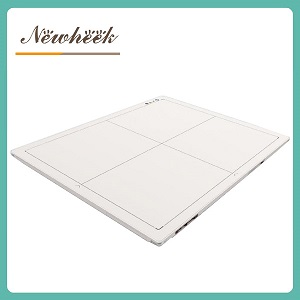
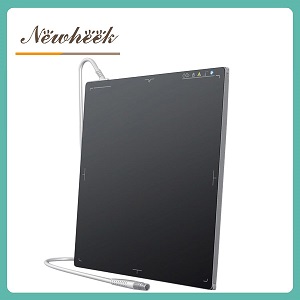
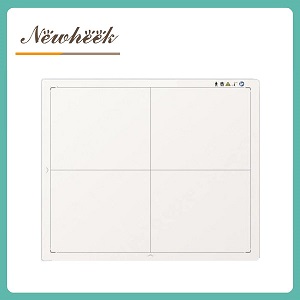
resolution decides whether a detector produces sharp images; its IP rating, drop resistance and load capacity decide where that detector is allowed to work at all. In bedside, emergency, ICU, veterinary and field radiography, detectors are rarely retired because images got soft — they are retired because liquid got inside, the panel was dropped, or a patient was wheeled onto it. Those three durability specs are measurable, comparable between vendors, and increasingly written directly into procurement documents. Here is how to read each one, and how to turn them into contract language before you buy.
One honest caveat up front: on many supplier websites — including detector catalogues across this industry — you will find beautiful spec sheets for pixel pitch and bit depth, but no published IP rating, drop height or load figure. That silence is itself information. A buyer who asks for these three numbers in writing, and gets them, has learned something a glossy brochure will never tell them.
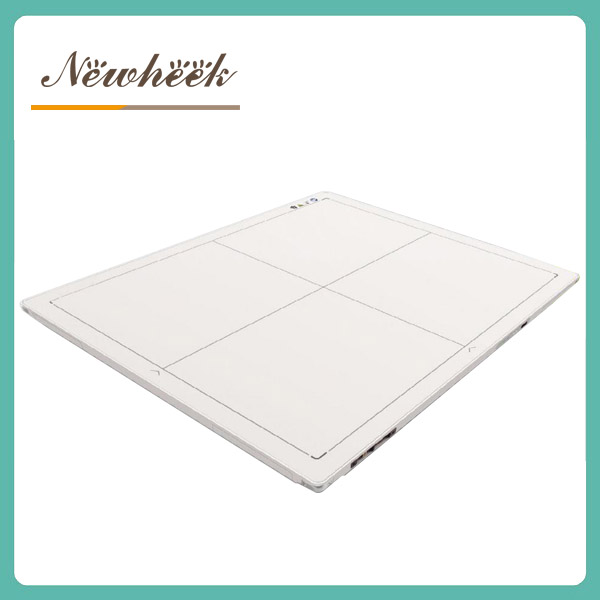
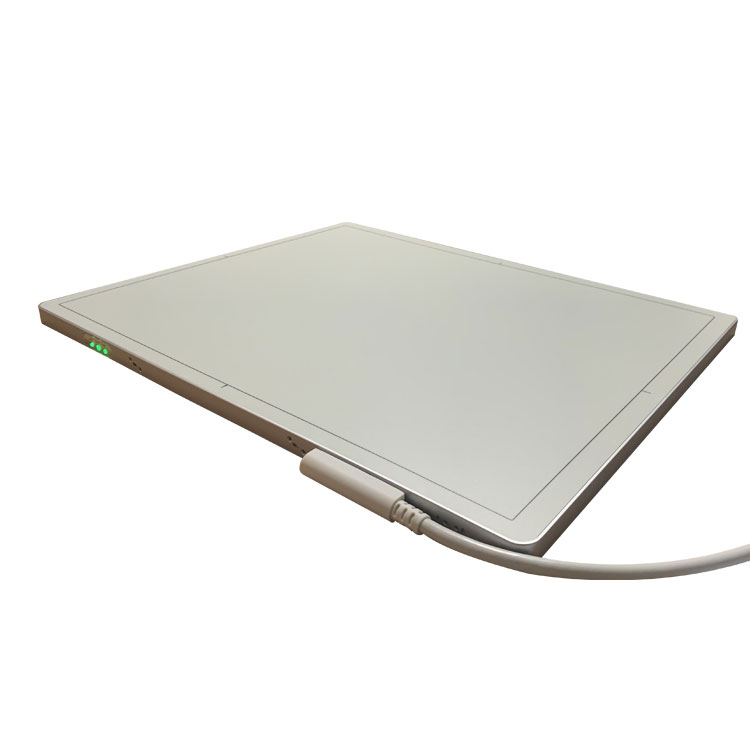
A wireless 14×17 flat panel detector — the form factor most exposed to fluids, handling and patient weight in bedside and veterinary work.
Durability used to be a footnote. It is now a line item in public tenders and a headline topic in market research.
Consider a recent example from public procurement: a 2026 government tender for wireless DR flat panel detectors published on the Philippine Government Electronic Procurement System (PhilGEPS) by a city government listed, among its mandatory technical requirements:
None of these are marketing adjectives. Each is a number a bidder must either meet or lose the contract. Market analysts have reached the same conclusion from the demand side: Econ Market Research (2026) lists durability and system compatibility alongside dose efficiency and wireless connectivity as the criteria purchasing decisions now pivot on, and HDIN Research (2026) reports that drop-resistant, lightweight flexible substrates are moving from niche field applications into high-throughput mobile and ICU workflows precisely because they reduce mechanical sensor-failure rates.
The pattern is clear: the questions worth asking a detector supplier in 2026 are the ones a tender committee already asks.
An IP (Ingress Protection) code has two digits. The first rates dust protection from 0 to 6; the second rates liquid protection from 0 to 8. The digits are not interchangeable, and the gap between adjacent levels is bigger than most buyers assume.
| Code | Dust (1st digit) | Liquid (2nd digit) | What it means in a clinic |
|---|---|---|---|
| IPX3 | unrated | spraying water, any angle | survives splashes; wiping with a damp cloth is fine, rinsing is not |
| IP56 | dust-protected (some ingress allowed) | powerful jets | tolerates wash-down near the panel; submersion still off-limits |
| IP67 | fully dust-tight | immersion up to 1 m / 30 min | the current benchmark in DR tenders; handles disinfectant-heavy cleaning routines |
| IP68 | fully dust-tight | continuous immersion beyond 1 m | top published level among cassette detectors; headroom for the worst days |
Three distinctions buyers routinely miss:
An unrated housing may tolerate a disinfectant wipe. Only a rated second digit of 5 or higher guarantees the panel survives jets of liquid — which is what actually happens when someone cleans a table, or a canine patient shakes beside the detector.
IPX3 means the vendor tested liquid ingress but never certified dust. In a veterinary or construction-site NDT setting, dust is the faster killer. Ask for both digits, always.
A detached cable port, a worn gasket or an added accessory can invalidate the rating. One major vendor’s IP68-rated cassette, for example, achieves the figure with a sealed magnesium-and-carbon-fiber unibody — the rating and the housing design are inseparable.
Published figures among current cassette detectors range from 1.0 m to 1.5 m, roughly the height of a detector being carried at waist level or slipping off a table edge. One Japanese imaging vendor goes further and certifies its glassless-panel detector against MIL-STD-810G, the US military environmental-test standard, alongside an IPX56 liquid rating — while cutting panel weight to under 2 kg by removing the glass substrate entirely. The physics is unforgiving: a dropped detector usually does not fail gracefully. Scintillator cracks and TFT line defects produce dead columns that no recalibration removes. A 1.0 m drop specification, verified in writing, is cheap insurance.
Load ratings come in two flavors, and tender documents ask for both:
A vendor who publishes only one of the two numbers has not necessarily hidden the other — but you will not know until you ask. Put both in the RFQ.
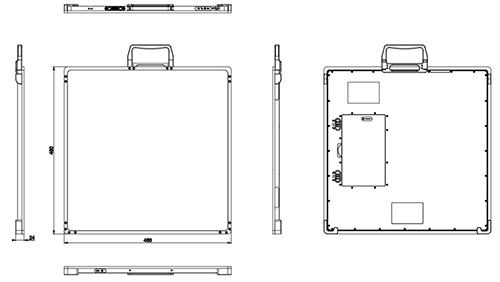
Dimension drawing of a 14×17 cassette detector (460 mm front, 15 mm thin). Weight and thickness belong on the durability checklist next to the load figures.
The failure chain in busy environments is well documented across service contexts: liquids enter through seams and connector ports, shorting readout electronics or slowly degrading the sensor; a drop cracks the panel or its scintillator layer irreversibly. In veterinary clinics the aggressors multiply — body fluids, fur, disinfectant overspray, frequent repositioning between rooms or vehicles. In mobile and ICU radiography it is corridor transport, bed transfers and crowded spaces. In industrial NDT it is dust, jobsite handling and weather.
This is also why the housing matters as much as the rating. Carbon-fiber and magnesium-alloy fronts deliver stiffness at low weight; polyimide-based flexible substrates — the trend HDIN Research highlights — remove brittle glass from the stack altogether. For a plain-language comparison of housing materials, see our earlier piece on how the material composition of a detector housing impacts durability and performance. And note the distinction: a removable protective cover is an accessory, not a rating — it supplements but does not replace the ingress protection built into the sealed unit.
A dedicated protective shell. Note: an accessory like this supplements — but does not replace — the ingress protection rating of the sealed detector itself.
Whatever vendor you evaluate, these six items convert durability from brochure talk into verifiable contract language:
Items 1–3 mirror what public tenders already demand; items 4–6 are where clinical reality and warranty law meet. A supplier who answers all six in writing is a supplier ready for bedside, veterinary and field work. One that answers only in adjectives has answered, too.
IP67 (dust-tight, 1 m immersion for 30 minutes) is the level specified in recent government DR tenders and covers routine disinfectant cleaning and splash exposure. IP68 adds headroom for continuous immersion — valuable in high-volume wash-down environments, but not a requirement in most clinic protocols. Match the level to your actual cleaning procedure, and get the approved-disinfectant list either way.
No. An IP rating certifies protection against dust and water ingress only. Chemical compatibility with specific disinfectants is a separate property — ask the vendor for a tested disinfectant list with concentrations. Nothing in a standard DR detector is rated for autoclave cycles.
Distributed load is weight spread across the panel surface (a patient lying flat); point load is the same weight concentrated through a small area (a heel or elbow). Leading cassettes publish roughly 400 kg distributed and 200 kg point load. A panel can meet one figure and fail the other, so both belong in the RFQ.
Removing the glass substrate eliminates the most brittle layer in the stack, and market research (HDIN Research, 2026) links this construction to lower mechanical failure rates in mobile and ICU workflows. It is a genuine engineering trend, not marketing — but drop resistance still depends on the complete housing design, so judge the finished product’s tested drop height, not the substrate alone.
They answer different questions. Pixel pitch, bit depth and dose efficiency determine image quality for every study, every day; IP rating, drop height and load capacity determine whether the detector survives the environment it works in. For room-based, wall-buckied general radiography, image specs usually lead. For bedside, mobile, veterinary and field use, durability often decides total cost of ownership first — which is why a structured DR detector selection checklist weighs both columns.
A detector’s durability specs are among the easiest things to verify and the easiest things to forget. Before your next detector purchase, send the six-line checklist above to every vendor on your shortlist and compare the written answers side by side. If you would like help matching a detector to a specific environment — table work, veterinary practice, mobile service or industrial inspection — tell us your workflow and we will point you to the right configuration.
Contact: admin@newheek.cn | WhatsApp +86 19062611512
Author:Newheek-Detector
Tel:+86 19062611512
Email:admin@newheek.cn
Company:Weifang Newheek Electronic Tech Co., Ltd.