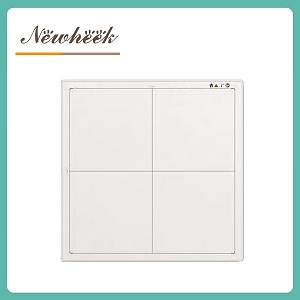
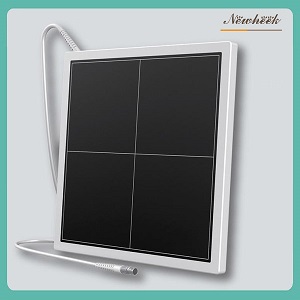
Quick answer: a flat panel detector does not expire on a date; it wears out through a short list of identifiable mechanisms — scintillator aging, impact damage, battery end-of-life, and connector wear. A detector that has been handled carefully can serve a room for many years, while a mistreated one can be done in far less time. That is why the useful question is not “how many years,” but “what is wearing out inside my unit, and does the math favor repairing it or replacing it.”
Contact: Email admin@newheek.cn · Phone/WhatsApp: +86 19062611512
This article is written for the decision moment: you have a detector that is getting old, misbehaving, or both, and you need to choose between sending it for repair and ordering a replacement. We will walk through what actually ages inside the panel, the four failure modes buyers meet in practice, a seven-question repair-vs-replace checklist, and the cases where replacement has nothing to do with age at all.

One honest note before we start: you will not find a single universal lifespan figure here, because none exists that survives contact with real usage. Manufacturers quote service-life figures under specific test conditions, and two clinics that buy the same panel on the same day can reach very different outcomes depending on caseload, transport, and environment. What we can do is give you the mechanisms and the decision logic — the parts that actually hold up.
A flat panel detector looks like a single black box, but it ages in four separate places, and knowing which one is failing tells you most of what you need to know about repairability.
The scintillator layer converts X-rays into visible light, and it is the component most exposed to cumulative dose. Over a long service life, a scintillator’s light output can gradually decline, which shows up as slightly higher exposure requirements for the same image quality — a drift so slow that most rooms never notice it year to year. Scintillator choice matters here: cesium iodide structures and other designs age differently, and the practical differences are exactly the kind of thing a supplier should be able to explain in writing rather than in marketing language. For what the scintillator actually does in daily imaging, see our article on what 3.6 lp/mm, 16-bit, and a CsI scintillator actually do in the exam room.
Beneath the scintillator sits the amorphous silicon (or IGZO, or CMOS) panel that reads the signal out pixel by pixel. This layer does not “wear out” from use in the mechanical sense, but it can develop dead pixel clusters, most often after physical shock or thermal stress. A few scattered dead pixels are usually calibrated out and invisible; a growing cluster in a diagnostically important area is not. The backplane technology also shapes how the panel behaves under long duty cycles — we compare the three main types in a-Si vs IGZO vs CMOS: how flat panel detector backplanes differ.
For a wireless detector, the battery is the one component with a genuinely finite, countable life. Batteries are rated in charge cycles, and every cycle moves the unit closer to shorter uptime per charge. This is also the one component where replacement is routine, inexpensive by comparison, and should be planned rather than reacted to. If you are weighing a cable-free workflow, our field-tested wired-or-wireless decision framework for veterinary clinics covers how battery planning fits into the overall choice.
Wired units live and die by their connectors: a data port that gets yanked, a cable that gets rolled over by a stand, a housing edge that takes the impact when a panel slips — these are ordinary wear items. Housing integrity matters more than it sounds, because the seals that keep dust and moisture out of the electronics are part of the same physical structure. A detector can be electronically healthy and still fail in the field because its enclosure no longer protects it.
Reading the list above top to bottom, real-world failures cluster into four groups:
Notice what is missing from this list: “the detector got old.” Age itself does not appear in the image. Specific mechanisms do — and each mechanism has its own repair economics.
When a detector starts misbehaving, work through these seven questions in order. By the end, the answer is usually obvious.
Two of these seven questions deserve their own conversations with any supplier you are evaluating — we have collected them, along with five others, in the checklist at the end of this article.
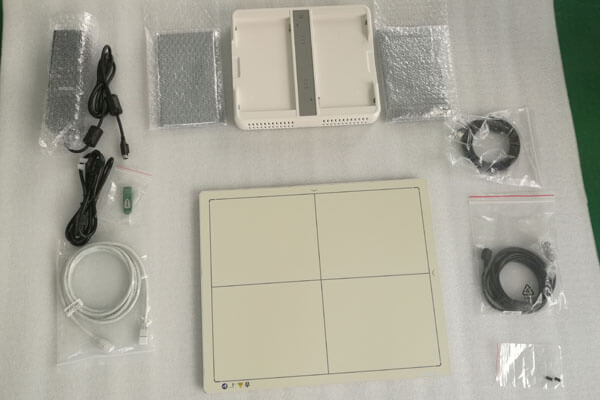
A meaningful share of detector replacements happen while the old unit still functions. The trigger is a workflow change, not a failure:
In these cases, the aging question flips: the old panel becomes a backup unit, a second-room panel, or a trade-in candidate. Planning that transition while the unit still works is almost always cheaper than being forced into it after a failure.
The sticker price of “keep using the old one” is zero, which is exactly why it is easy to overpay for it in hidden costs: recalibration visits, repeat exposures when images drift, battery swaps on shortening cycles, and the standby risk of an unplanned outage in a room that has no fallback. None of these costs show up on a quote, and none of them can be responsibly reduced to a single universal number — they depend on your caseload and your service contract. What you can do is track them for one quarter. If the pattern is “something small every month,” the trend line, not any single invoice, is the real argument for replacement.
This is also where the detector’s operating environment earns its keep: stable power, sensible handling routines, and storage within the specified temperature and humidity range all push the wear curves in your favor. Our earlier piece on the durability specs that decide where a flat panel detector can really work maps which specifications predict survival in which setting — a useful companion when you audit your own room.
Whether you are requesting a repair quote or pricing a replacement, put these questions in writing:
A supplier who answers these crisply is telling you how they will behave after the sale. A supplier who goes vague on question 3 or 5 is telling you something too.
Both, through different mechanisms. Cumulative dose affects the scintillator gradually over a long service life; impact and mishandling cause sudden, localized damage. A panel that is handled well can stay diagnostically useful for many years, which is why handling discipline is the cheapest lifespan-extension program that exists.
It depends on which of the four components failed. Wear items — batteries, cables, connectors — are routinely and sensibly repaired or swapped. Deep panel damage rarely justifies repair once you compare the written repair quote against a written replacement quote and weigh the remaining support window of each path.
Battery life is counted in charge cycles, not years, and it shortens noticeably as the cycles accumulate. Plan the replacement when charge duration stops covering your working shift — that is the practical signal, and the swap itself is a routine service item rather than a repair event.
Often yes, and it is one of the better outcomes for an aging panel: a unit that no longer meets a busy primary room’s demands may still serve a low-volume backup role, a second room, or overflow imaging — provided its calibration is maintained and its remaining support window is confirmed with the supplier.
Two written quotes covering the same scope — repair versus equivalent replacement — each stating cost, turnaround, warranty, and remaining support window. Verbal assurances make this decision unfinishable; paper makes it take ten minutes.
Flat panel detectors do not die of old age; they die of specific, mostly foreseeable causes. Learn the four aging mechanisms, demand written quotes on both paths, and let the seven questions — not the calendar — make the call. If you would like a quote for a replacement panel, or a second opinion on a repair estimate you already hold, reach out and we will walk through your situation with you.
Contact: Email admin@newheek.cn · Phone/WhatsApp: +86 19062611512
Related reading: durability specs by setting · 14×17 vs 17×17 · 17×17 detectors · wireless cassettes
Author:Newheek-Detector
Tel:+86 19062611512
Email:admin@newheek.cn
Company:Weifang Newheek Electronic Tech Co., Ltd.