Quick answer: a flat panel detector does not have to live its whole life bolted behind a wall stand. A mobile trolley-style upright holder — a column, a sliding carriage, a cassette holder, a support arm, and a wheeled base — gives one detector a second workplace: beside the patient in a temporary room, at a screening campaign in the field, or anywhere an upright projection is needed without a dedicated radiography installation. Below we decode what such a stand actually asks of your detector, size by size and millimeter by millimeter, using the published specifications of a current trolley-style model.
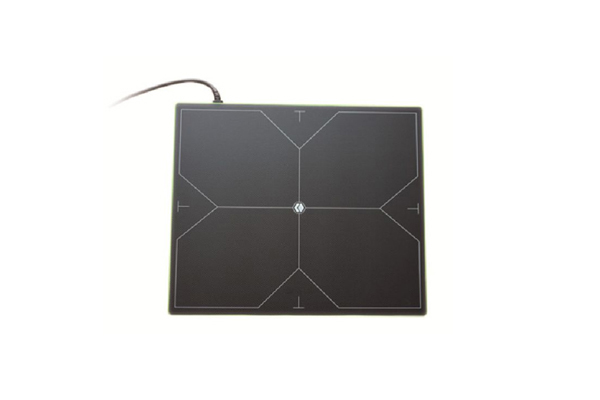
Most flat panel detectors are bought for one room and one mounting: a fixed wall bucky or a table slot. That is fine until the day the workload moves — an outreach screening program, a field rescue deployment, a second consulting room that cannot justify a full radiography installation, or simply two rooms that each need upright imaging a few hours a week.
The honest answer in most of those situations is not a second detector. A flat panel is the costly, fragile, calibration-sensitive part of the imaging chain; duplicating it to idle in a second room is poor economics. The affordable answer is to move the mounting, not the detector’s home: a wheeled upright stand that accepts the same detector, rolls to where the imaging happens, and locks into position in seconds.
We have covered whether flat panel detectors can work in mobile X-ray machines before — that article is about the machine side. This one is about the quieter half of the same question: the stand that holds the panel while the machine does its work.
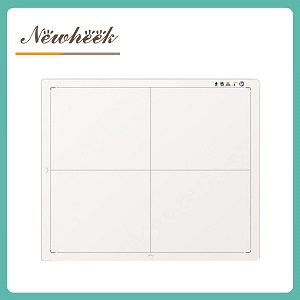
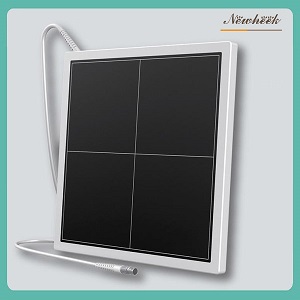
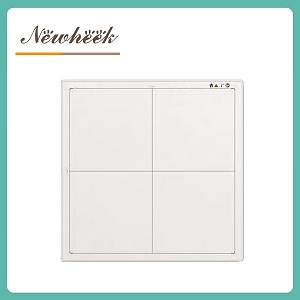
The cassette holder accepts the two formats that dominate general radiography: 17″ × 17″ and 14″ × 17″. That covers the full range of what a detector buyer is likely to own in this class — a square panel for chest and upright work, or a rectangular cassette-size panel for general studies. If you are still deciding which size to buy, our 17×17 detector overview and 14×17 detector overview compare the two formats in detail, and this guide to specialty detector sizes explains where the less common formats earn their keep.
The same holder takes three kinds of image receptors:
For a facility mid-transition, that means the stand does not strand you on either side of an upgrade. Buy it with your CR plates today, drop in a flat panel tomorrow, and the hardware does not change. For a mixed fleet — one DR room, one film legacy room — one mobile stand can genuinely serve both.
The slot accepts receptors up to 29 mm thick, and this is the specification buyers underestimate. A film cassette is a couple of centimeters of aluminum and phosphor. A CR plate is similar. But a modern wireless flat panel detector carries a battery, a capture screen, and grip surfaces inside its housing — it is a thicker object than any cassette ever was, and a slot designed only for film will refuse it.
Before you match any detector to any stand, measure the housing, not the brochure photo: total thickness at the battery cover, plus any attached cable strain relief on a wired model. If the total is under 29 mm, it slots in; if it is over, no amount of “should fit” will help. Our guide to choosing a bucky stand for a DR detector walks through that matching process step by step, and this overview of dedicated holders for DR plates covers the holder types in general.
A stand is only as useful as the positions it can reach. The published figures on this model:
Once the carriage is locked at the working height, the support arm swings 180 degrees left-right and travels roughly 30 cm up-down. Practically, that means the operator fine-tunes the receptor position around the patient — centering on the anatomy, adjusting for a seated versus standing patient — without re-parking the whole trolley. The patient stands still; the last centimeters are the arm’s job.
With the carriage raised, the top edge of the cassette holder reaches up to 2070 mm — comfortably above the shoulders of a tall standing patient for upright chest work. With the carriage lowered, the bottom edge of the holder goes all the way to the floor. That floor-level reach is the feature most buyers do not know to ask about and miss first: lower-leg, ankle, and foot projections, including oblique views down to the feet, become single-workflow examinations instead of an awkward improvisation with the panel balanced against a stool.
Overall column height is 1740 mm, with the push handle at 960 mm — a natural steering height for an average adult, which matters more than it sounds when the stand is being repositioned between patients a dozen times a day. The 480 × 480 mm base keeps the footprint compact enough to pass through ordinary doorways and to park against a wall without dominating a small room.
The whole assembly is deliberately lightweight for its class, and that is not a cost-saving accident — it is the design brief. This category of stand exists for deployments where a fixed wall bucky cannot go:
One boundary worth stating plainly, because it prevents the most common category mistake: this stand carries the detector only. It is not a mobile X-ray machine — there is no generator, no tube, no exposure console on board. It works as the receptor side of a pairing: a portable or mobile X-ray source exposes, the stand holds the panel steady and correctly positioned. If your use case needs the whole imaging chain self-propelled to the bedside, that is a different product class, and our room-by-room guide to what six imaging settings actually ask of a detector helps sort which environment needs which.
| Item | Specification |
|---|---|
| Intended anatomy | Head, chest, abdomen, pelvis and other upright projections |
| Construction | Column, sliding carriage, cassette holder, support arm, mobile base |
| Accepted receptors | 17″ × 17″ and 14″ × 17″ — DR flat panel detectors, CR IP plates, conventional film cassettes |
| Slot width | Accepts receptors up to 29 mm thick |
| Overall height | 1740 mm |
| Handle height | 960 mm from floor |
| Base footprint | 480 mm × 480 mm |
| Arm movement (carriage locked) | 180° left-right swing; approx. 30 cm up-down travel |
| Cassette holder travel | Top edge up to 2070 mm; bottom edge down to floor level |
| Special projections | Oblique radiography down to the feet |
| Weight class | Lightweight overall, suited to field rescue and outreach screening |
If you are pairing the stand with a wireless panel, our wireless cassette-size detector page lists the housing details you will need for the thickness check, and this guide to vertical stands for wireless plates covers the fixed-installation counterpart.
Any detector in the two accepted formats — 17×17 or 14×17 — whose total housing thickness is 29 mm or less. Measure the housing including the battery cover and any cable strain relief before ordering. Nearly all cassette-format panels are designed with exactly this class of holder in mind, but measurement beats assumption every time.
Yes — the slot is designed for all three receptor types. Facilities transitioning from CR or film to DR can keep the stand through the upgrade; the holder does not care which generation of receptor is slotted in.
Yes. With the carriage lowered, the bottom edge of the cassette holder reaches floor level, and the arm supports oblique projections down to the feet. This is one of the practical differences between a trolley-style upright stand and improvising with a wall bucky that stops at shin height.
No. The stand is the detector side of the imaging chain — it positions and holds the receptor. The X-ray source (a portable or mobile unit) comes separately. Think of it as giving your detector a second, movable workplace, not as a complete imaging device.
That is the design intent: the lightweight build, compact base, and wheels exist for field rescue deployments and outreach screening campaigns. Do confirm the ground is firm and level before use, and treat the travel route — doorways, thresholds, ramps — as part of the deployment plan.
If your detector deserves a second workplace — or you are planning a screening deployment and want the stand, detector, and source confirmed as one working set — tell us the detector model and housing thickness, and we will confirm the fit before you order.
Author:Newheek-Detector
Tel:+86 19062611512
Email:admin@newheek.cn
Company:Weifang Newheek Electronic Tech Co., Ltd.