A DR detector RFQ (request for quotation) is not a price request — it is a specification contract. A well-written RFQ lists four groups of items: imaging specifications (scintillator, pixel pitch, bit depth, active area), environmental and durability ratings (ingress protection, load, drop), integration requirements (trigger mode, interface, software workflow), and commercial-service terms (warranty scope, spare parts, calibration support, lead time). Every line should be written so that the supplier’s answer can be verified with a document — a datasheet, a test report, or a written commitment. If a line item cannot be verified, it does not belong in the RFQ.
This checklist is written for hospitals, veterinary clinics, imaging centers and integrators who are comparing flat panel detectors across suppliers. It protects you in two directions: against vague answers before you sign, and against disputes after delivery.
Two detectors can look identical on a web page and behave completely differently in a room. The difference hides in details that never make it into marketing copy: how the panel triggers an exposure, what ingress protection it actually carries, whether the battery is hot-swappable, and who pays for calibration in year three.
A structured RFQ forces every supplier to answer the same questions in the same order, which makes comparison possible. It also shifts the burden of proof: instead of you asking “is it waterproof?” after a spill, the supplier states the ingress protection rating in writing — and that statement becomes part of the deal.

These are the core technical items. For each one, write the requirement, not the brand:
| RFQ line item | What to require | How to verify |
|---|---|---|
| Detector technology | Amorphous silicon (a-SI) or stated alternative | Datasheet section “detector technology” |
| Scintillator type | CsI or GOS, stated explicitly | Datasheet; ask whether it is bonded or deposited |
| Active imaging area | Size in mm or inches (e.g. 17×17 in / 43×43 cm class) | Datasheet “active area” in mm |
| Pixel matrix and pitch | Matrix (e.g. 3072×3072) and pitch in μm | Datasheet; both numbers together |
| AD conversion | Bit depth (14 or 16 bit) | Datasheet “AD conversion” |
| Spatial resolution | Lp/mm value | Datasheet; ask for the measuring condition |
| Image generation time | Seconds to preview image | Datasheet or live demo |
A practical tip: state your minimums, not exact values. Writing “pixel pitch ≤ 150 μm” lets suppliers with better figures compete; writing “= 150 μm” locks you out of them. If you are unsure what the numbers mean in practice, our explainer on what lp/mm, bit depth and a CsI scintillator actually do in the exam room walks through each one in plain language.
This is where detectors actually fail, and where the weakest suppliers reveal themselves. Require, at minimum:
Our article on durability specs — IP, drop and load explains why these numbers decide where a detector can really be used, and which environments rule out which ratings.
A detector that cannot talk to your room is a paperweight. These lines are the ones most often missing from RFQs, and the most expensive to discover after delivery:
| RFQ line item | What to require | How to verify |
|---|---|---|
| Trigger mode | AED (automatic exposure detection) and/or software trigger, generator interface | Ask which trigger methods the panel supports and how it syncs with your generator |
| Connection interface | Wired (e.g. GigE) and/or wireless (Wi-Fi standard) | Datasheet interface section |
| Acquisition software | Included workstation software; OS compatibility; language options | Written software scope; demo with your workflow |
| PACS / DICOM connection | Whether and how images reach your PACS | Ask the supplier to state the connection path in writing |
| Battery (wireless panels) | Autonomy in hours, charging method, replaceability | Datasheet; ask whether batteries are user-replaceable |
Write your existing room into the RFQ: generator model and age, existing software, network environment. A supplier who answers “yes, compatible” without asking these questions is guessing.
The detector itself is a fixed cost; downtime is not. Cover these terms in writing:
Here is a compact skeleton you can paste into your own document. Fill the bracketed values with your requirements:
[Wired / wireless] flat panel detector, cassette size [14×17 / 17×17] inch, for [medical / veterinary / NDT] radiography. Quantity: [n]. Destination market: [country — so the supplier names the right compliance path].
However attractive a quotation looks, these responses are red flags:
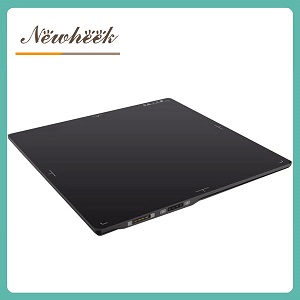
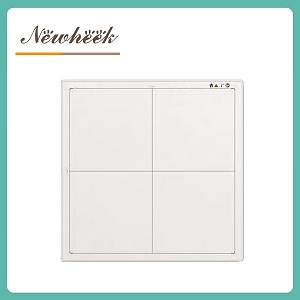
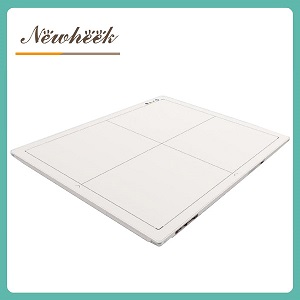
Most buyers in this market are choosing between two physical formats, and the RFQ emphasis differs slightly for each. A compact wired cassette-size panel is typically specified for fixed rooms and bucky-tray work; a wireless panel trades a connection cable for battery and Wi-Fi considerations, which is why Group 3 grows when you specify wireless. Our 14×17 vs 17×17 size comparison covers the format decision, and the wired vs wireless decision covers the connection trade-off. If you are still at the “how do I even choose” stage, the general selection guide is the broader starting point.
When you shortlist suppliers, send the checklist from the section above to each of them — identical text, no rewording. The quality and completeness of the responses will tell you more about the suppliers than any brochure.
An RFQ asks suppliers to price a defined specification; an RFP asks them to propose a solution to a defined problem. For a flat panel detector — a well-defined, spec-driven product — an RFQ is almost always the right tool. Use an RFP only when the project includes room redesign, multi-room rollout or unknown integration.
The ones you cannot verify after delivery without a document: ingress protection, load and drop ratings, trigger compatibility with your generator, and warranty exclusions. Image-quality figures (pixel pitch, bit depth, lp/mm) are easier to compare from datasheets; the durability and integration lines are where RFQ discipline pays off.
In the RFQ text, imaging specs come first — they define the product. But in your evaluation weighting, give durability and integration terms equal or higher priority: they are the fields most often left vague, and the ones that generate service calls later.
Three levels: the datasheet (baseline), a test or calibration report on request (better), and a live demonstration with your own generator and workflow (best). For critical projects, ask for a reference installation you can contact.
Yes — the four groups are the same. Adjust the values: veterinary work often stresses battery autonomy and animal-clinic cleaning (ingress protection), while NDT stresses pixel pitch for defect detail and housing robustness for field use. The structure of the checklist does not change.
Preparing a detector RFQ and want a supplier who answers every line in writing? Send your checklist to our team — or ask for ours. Email: admin@newheek.cn | WhatsApp: +86 19062611512
Author:Newheek-Detector
Tel:+86 19062611512
Email:admin@newheek.cn
Company:Weifang Newheek Electronic Tech Co., Ltd.