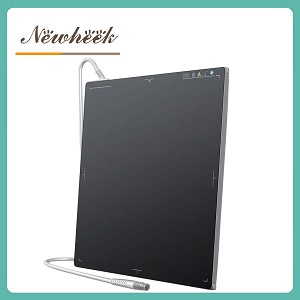
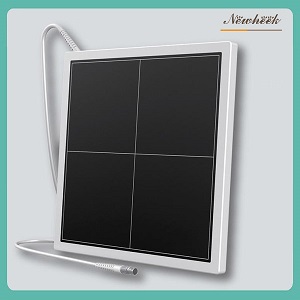
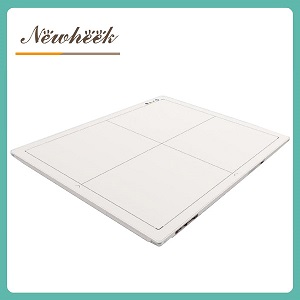
A photon-counting detector records each individual X-ray photon and sorts it by energy, instead of adding up all arriving energy into a single signal per pixel. It is the most-discussed technology shift in medical imaging right now: photon-counting CT is already deployed in premium clinical systems, and industry analysts have called it the “Holy Grail” of imaging. But in general radiography — the flat panel detector that sits in a bucky tray or gets carried to a bedside — every panel you can actually buy today is still an energy-integrating detector. That is not a compromise you are making; it is the mature mainstream of the market. This article explains what photon counting actually changes, why CT got it first, and what it means for a detector purchase you need to make now.
Three things converged in the last two years to push photon counting from research papers into procurement conversations:
When a technology moves from “lab curiosity” to “market report headline,” buyers start asking the right question: does this change what I should buy today? The rest of this article is the answer for general radiography.
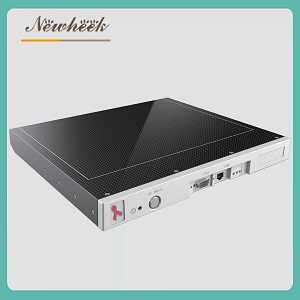
Nearly every flat panel detector in general radiography — medical, veterinary or industrial — works by energy integration. In an indirect-conversion panel, a scintillator layer (typically CsI or GOS) converts X-rays into visible light, a photodiode array turns that light into charge, and the readout electronics sum the charge in each pixel into one signal value. In a direct-conversion panel, a photoconductor like amorphous selenium turns X-rays into charge directly. But in both cases the fundamental step is the same: all the photons that hit a pixel during the exposure are blended into one number.
That blended number works extremely well — which is why energy-integrating panels dominate every market segment. If you want to understand how the different backplane technologies (a-Si, IGZO, CMOS) compare within this approach, our article on how flat panel detector backplanes differ covers it in depth, and the plain-language spec explainer shows what each datasheet number does in the exam room.
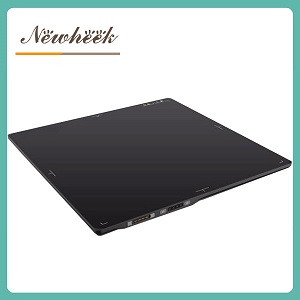
A photon-counting detector puts a threshold on the signal: only real photon events above the noise floor are registered, and each one is assigned to an energy bin. The consequences are structural, not incremental:
| Aspect | Energy-integrating panel (today’s DR) | Photon-counting panel (emerging) |
|---|---|---|
| Signal per pixel | Sum of all deposited energy | Count of individual photons, each with an energy value |
| Electronic noise | Adds to the signal | Falls below the counting threshold — not registered |
| Energy information | Lost in the sum | Preserved in energy bins (spectral imaging) |
| Material separation | Not directly possible | Bone / soft tissue / contrast agents can be separated |
| Scintillator blur | Light spread in the scintillator limits sharpness | No scintillator needed — a path to finer detail |
Two caveats keep this honest. First, these are structural advantages: how much of each one reaches a real image depends on the implementation. Second, the materials involved — cadmium zinc telluride (CZT) and cadmium telluride (CdTe) — are demanding to produce, especially in the large, flat, robust and affordable form factor that radiography requires.
The clinical payoff of photon counting is largest where dose reduction and spectral separation matter most, and where the system can afford premium components. That describes high-end CT, not a bucky tray.
This does not mean radiography stands still. Specialized detectors already segment by task — high-resolution mammography sensors, robust industrial NDT panels, lightweight wireless cassettes for veterinary work — and each of those niches optimizes for a different requirement. Photon counting will arrive in radiography as another specialization, not as a wholesale replacement. Detector manufacturers themselves position it this way: the underlying innovations are influencing design priorities across the imaging landscape, while current deployment remains in premium CT systems (Varex Imaging, 2026).
Practically, three things:
1. An energy-integrating panel is not “old stock.” It is the mature, competitive mainstream of general radiography. Independent buyer guidance published in 2026 notes that DQE differences between current-generation DR panels have become small enough that workflow, service and total cost of ownership matter more to the outcome than the last percentage point of detector performance (MedEquip Directory, 2026). The decision variables that actually determine satisfaction — trigger compatibility, ingress protection, battery autonomy, service terms — are unchanged by anything happening in photon counting. Our durability guide and wired vs wireless comparison cover the two biggest of those variables.
2. Nothing in your infrastructure becomes obsolete. Rooms, stands, generators, PACS connections and DICOM workflow carry forward. Photon counting, when it reaches radiography, will arrive as new detector hardware plus updated acquisition software — not as a rebuild of everything around it.
3. Ask every supplier the three photon-counting questions now. Not because you should wait, but because the answers reveal how a supplier thinks about the future:
No — not at commercial scale. Photon-counting detection is deployed in premium clinical CT systems, and detector development for radiography is active, but the panels offered for general radiography today are energy-integrating detectors. Treat any claim of a mainstream “photon-counting DR panel” as something to verify with documentation.
No. A direct-conversion panel (amorphous selenium) converts X-rays into charge without a scintillator — but it still sums that charge into one integrated signal per pixel. Photon counting is a different step: individual photons are registered and sorted by energy. Direct conversion describes how charge is created; photon counting describes how the signal is read.
For a general radiography need today, no. The energy-integrating market is mature and competitive, infrastructure carries forward, and the timeline for mainstream photon-counting radiography panels is not something a purchase decision should be scheduled around. Buy on the specs that are verifiable today; ask about the roadmap as a supplier-quality question.
In CT, low-dose acquisition is one of the technology’s headline benefits. For radiography, dose reduction is never automatic — it depends on acquisition practice, exposure discipline and the ALARA principle, regardless of detector type. Do not accept “photon counting means lower dose” as a substitute for dose management at the institutional level.
Three things: the product roadmap across the supported service period, whether the acquisition software platform can be upgraded rather than replaced, and how today’s specifications are documented. The third one matters most — future upgrade paths are negotiated on the precision of what you specify now.
Choosing a flat panel detector for a room, a clinic or an NDT line? Our team works with buyers across medical, veterinary and industrial applications and answers specification questions in writing. Email: admin@newheek.cn | WhatsApp: +86 19062611512
Author:Newheek-Detector
Tel:+86 19062611512
Email:admin@newheek.cn
Company:Weifang Newheek Electronic Tech Co., Ltd.