Quick answer: is CsI worth paying more for than GOS
CsI and GOS are the two scintillators behind most indirect-conversion flat panel detectors. CsI turns X-rays into light through column-shaped crystals, which keep the light narrow and give a sharper image at a lower dose. GOS is a powdered layer, cheaper to make and adequate for a great deal of routine work. The honest answer for a buyer is that the scintillator name alone does not decide the order: unchanged pixel pitch, DQE and the way the whole panel is built matter as much. Ask what the detector does in the room where it will be used, and compare the two versions on the same exposure rather than on the name of a material.
Most enquiries start the same way. A clinic has been quoted two panels that look identical on the outside, one at a noticeably higher price, and the difference on the sheet is a single line: caesium iodide instead of gadolinium oxysulfide. The sales reply usually says one is sharper and works at a lower dose, which is true but not enough to sign a purchase order on. The rest of this page is about the questions worth asking before that line on the sheet becomes a decision.
What changes in the image when the scintillator changes
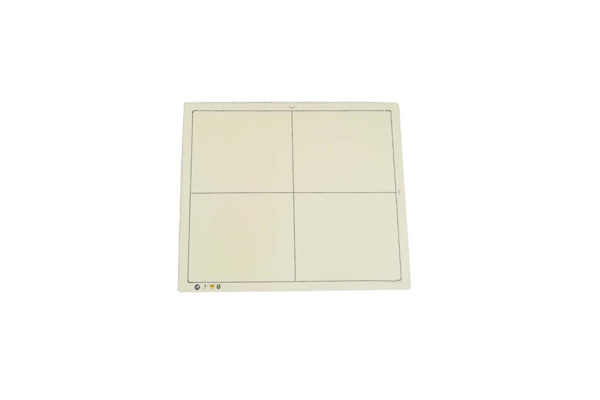
Both materials do the same job. An X-ray photon arrives, the scintillator converts it into visible light, and the thin-film transistor array below reads that light as charge. The difference is what happens to the light between the two layers. CsI grows in columns, so the light travels mostly straight down. GOS is a packed powder, and the light scatters sideways before it reaches the array. That sideways spread is why a fine detail can look softer on a GOS panel even when the pixel count on the sheet is the same.
This is a material distinction, not a quality grade. A well-built GOS detector with a sensible pixel pitch and good calibration can produce clean diagnostic images; a CsI panel with a poor readout chain will not rescue a rushed exposure. The site already has a short explanation of how the two scintillators are built, so this page stays with the buying question instead of repeating the chemistry.
Does the lower dose claim hold up outside the brochure
The dose argument for CsI is real and easy to overstate. Independent buyer guides describe CsI as more efficient at converting X-rays into useful light, which can allow a lower exposure for a comparable image. What those guides do not promise is a fixed percentage that applies to every room. The saved dose depends on the examination, the patient, the generator and the processing settings as much as on the scintillator.
A practical way to test the claim is to ask for sample images of the same phantom or the same examination taken with both versions, at the exposure the supplier recommends for each. If a clinic keeps a record of exposure index values, the comparison can be made on its own equipment during a trial. A single impressive image proves little. A set of images across a morning of routine work tells a buyer whether the dose advantage survives contact with an ordinary list. Dose decisions in radiography remain subject to the ALARA principle and local regulation; a material choice supports that goal but does not replace a dose programme.
When does the sharper image of CsI actually matter
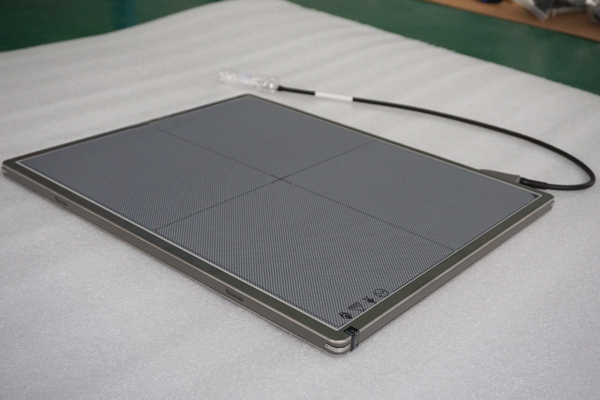
Sharpness is worth paying for when the examination depends on small detail. Paediatric work, extremities, dental and mammography-adjacent tasks all reward a detector that holds fine edges, and a smaller patient also makes the dose argument more relevant. In those rooms the extra cost of CsI is easier to justify, because the panel is being asked to resolve something small on a regular basis.
For a general radiography room doing chest, abdomen and a share of large-animal or bariatric work, the gap narrows. Bone and organ outlines are large structures. Positioning, motion and scatter often do more damage to the final image than the difference between two scintillators, and the additional cost may buy a benefit the room rarely uses. The 14×17 versus 17×17 comparison covers the coverage decision that usually has a larger effect on those lists than the scintillator does.
What does a GOS panel do well enough to keep the price down
GOS is the mature option. It is used widely, the production process is established, and the cost of the layer is lower than CsI. For a busy room where panels are handed between technicians, wheeled into position and cleaned several times a day, the practical question is often whether the detector survives the workflow rather than whether its scintillator is the most efficient one available. Spending the difference on a second panel or on protective handling can help a schedule more than upgrading every detector to CsI.
There is a reasonable case for a mixed room: one CsI panel kept for the cases that need fine detail and one or more GOS panels for the routine load. Before choosing that arrangement, check that the two panels can be read by the same workstation and acquisition software, and that any auto-exposure detection behaves consistently across both. A supplier who has supplied both configurations is in a better position to answer that than one who only sells a single type.
Why two datasheets with the same DQE number still cannot be compared directly
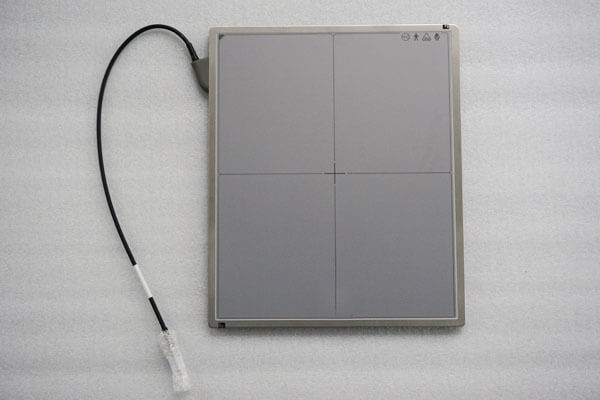
Buyers often try to settle the scintillator question by reading the DQE figure. That figure needs context. DQE is measured under stated beam quality and exposure conditions, and a number quoted at one spatial frequency is not the same as a number quoted at another. Standards such as IEC 62220-1 exist precisely so that measurements can be described in a comparable way, but a datasheet line that gives only a percentage has left out the conditions that make the percentage meaningful.
The same care applies to modulation transfer function, pixel pitch and bit depth. A smaller pixel pitch is often presented as an automatic improvement, which it is not; noise, dose and the scintillator all take part in the result. An earlier note on what the numbers on the sheet actually do in the exam room deals with the vocabulary. When comparing two suppliers, ask for the test conditions next to every performance number and keep the conditions attached to the number in the comparison sheet.
How should the two versions be tested before a purchase order goes out
The only comparison that matters is the one run on the intended work. Ask both suppliers for a demonstration that uses the generator, the grid and the processing settings of the room, not a factory set-up. Take the same examination on both panels, repeat it, and look at the images on the same monitor. Include one difficult case — a large patient, an uncooperative animal, or a position that has to be repeated — because that is where a scintillator choice either helps or disappears into the noise.
Record the exposure index and the number of repeats over a trial period if the supplier can leave a unit in place. The format comparison and the existing guide to choosing a DR detector set out the surrounding decisions. For background on how panel construction affects performance beyond the scintillator, the backplane comparison explains why the layer underneath the scintillator also deserves a question.
What belongs in the RFQ so the answers can be compared
Put the scintillator question in writing, alongside the other items that decide whether a panel works in the room. Ask which scintillator is fitted, and ask for the DQE value with its measurement conditions. Ask for sample images of the same examination with both versions, the recommended exposure for each, and the exposure index the system reports. Then add the questions that have nothing to do with materials: warranty terms, spare-part availability, calibration support and the period for which a replacement panel can be supplied.
An RFQ that asks only for CsI or GOS invites a one-word answer and gives the buyer nothing to compare. An RFQ that asks for conditions, images and service terms produces documents that can be placed side by side. The total cost of ownership note explains why the purchase price is only part of the comparison, and the infection control guide covers the cleaning routine that both scintillators must tolerate. Configuration and RFQ questions can be sent to the contact page.
FAQ
Is CsI the better choice over GOS in every room?
No. CsI limits light spread and can support a sharper image at a lower exposure, but the final image also depends on pixel pitch, readout electronics, calibration and the examination itself. For a general radiography room with large structures, the difference may be smaller than the difference made by positioning or repeats. Choose on the work the panel will do, not on the material name alone.
Does a CsI detector mean a lower radiation dose for every patient?
Not automatically. CsI converts X-rays into light efficiently, which can reduce the exposure needed for a comparable image, but the saved dose depends on technique, patient size, generator behaviour and processing. Ask for sample exposures and exposure index values from the intended room, and treat published percentages as general references rather than a figure promised for a specific examination.
Why is a CsI flat panel detector more expensive?
The scintillator costs more to produce, and a panel built around it is usually positioned as a higher specification product. The price difference is not a measure of overall quality on its own. Compare the full specification, the service terms and the images from a trial, and decide whether the applications in the room use the sharpness and dose advantage often enough to justify the difference.
Can CsI and GOS detectors be used in the same radiography room?
Yes, provided both are supported by the same acquisition software and workstation and the exposure workflow is checked for each panel. Check that automatic exposure detection triggers reliably with both, and that image routing and calibration records are kept separately. A mixed room can work well when one panel is reserved for detail-sensitive cases and the others carry the routine list.
What should be written next to a DQE value in a comparison sheet?
Record the beam quality, the exposure conditions and the spatial frequency at which the value was measured, together with the standard used for the measurement, such as IEC 62220-1. A percentage without those conditions cannot be compared fairly with a percentage from another supplier. Keep the conditions attached to the number rather than copying the headline figure into a table on its own.
Detector configuration and scintillator questions: admin@newheek.cn | WhatsApp: +86 19062611512